Environmental Performance
Management Approach
Responsible environmental management is one of GRI Renewable Industries’ core values and a cross-cutting element of the company’s strategy.
Decarbonization and circularity are the two pillars on which we are driving the transformation of our processes to achieve efficient use of resources (energy, materials, etc.) and a reduction in our environmental impact.
Responsible Environmental Management
GRI Renewable Industries’ commitment to the environment begins with the certification of its Environmental Management System under the ISO 14001 standard. Currently, 91% of the group’s plants are certified.
GRI Renewable Industries monitors the environmental impacts resulting from its operations, measuring its performance and identifying opportunities for improvement. The implementation of the Sygris tool as a means of tracking and measuring relevant environmental data and information continues to advance, with the definition of improvement actions for reporting and the reliability of Sygris data being the objectives established within GRI’s environmental management framework.
Likewise, as part of its commitment to sustainability and its sustainable culture, the company invests in more efficient technology and innovation to minimize its environmental impact, in alignment with the Sustainable Development Goals (SDGs), highlighting its strategy to address climate change, which enables it to move toward a carbon-neutral future.
Activities to raise environmental awareness among professionals at all plants are conducted periodically, typically coinciding with significant dates such as World Environment Day or Recycling Day.
To minimize the impact of potential environmental risks, GRI Renewable Industries sets aside financial provisions and maintains coverage in its insurance policies to address the occurrence of environmental risks:
- Environmental Liability Insurance
- Civil Liability Coverage for Sudden and Accidental Pollution under the General Civil Liability Policy.
In 2025, it was not necessary to activate the guarantees under the Environmental Liability Policy held by the Group due to any incident or accident at GRI.
This chapter summarizes the key environmental metrics, performance measurement, and most relevant initiatives.
Resources, provisions, and guarantees allocated to environmental prevention
The Group integrates the prevention and minimization of environmental impact into its industrial operations by incorporating environmental assets and investments into its production base, aimed at improving process efficiency, reducing consumption, and complying with applicable regulations. These resources are managed as part of the Group’s ordinary operations and are included in property, plant, and equipment, without constituting a separate line item.
Adopting a preventive management approach, the Group continuously monitors the environmental aspects associated with its operations. As of the end of the 2025 fiscal year, no material environmental contingencies or risks have been identified, nor has it been necessary to set aside specific provisions to cover such risks, consistent with what is reflected in the Consolidated Financial Statements.
Likewise, the GRI Group does not hold any guarantees, sureties, or pledged assets specifically linked to environmental obligations. This approach reflects a management strategy focused on compliance, regulatory anticipation, and the integration of environmental criteria into operational decision-making, ensuring consistency between reported financial and non-financial information.
Energy consumption
Internal energy consumption
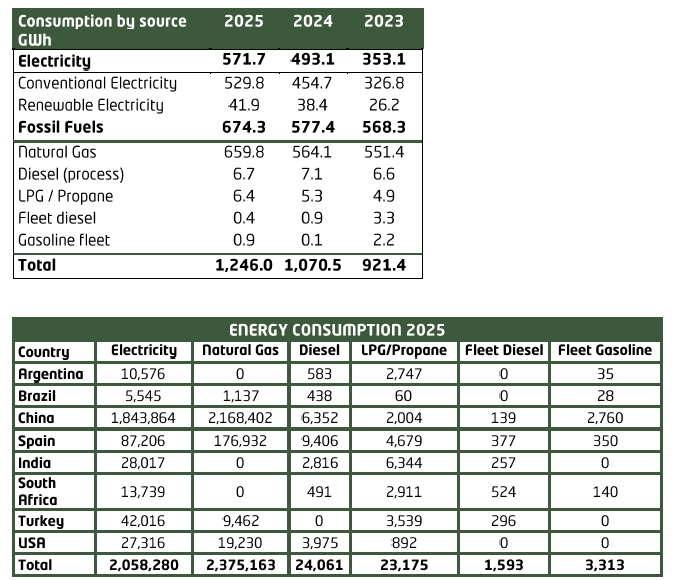
Total energy consumption in fiscal year 2025 was 1,246 GWh, of which 571.7 GWh was electricity and 674.3 GWh was fossil fuels. The mix of internal energy consumption by source type was as follows:
- Electricity: 46%
- Fossil fuels: 54%
Compared to the previous year, total energy consumption increased by 12%. This increase is mainly due to higher fossil fuel consumption (7%) and an increase in electricity use (+16%).
Energy Intensity
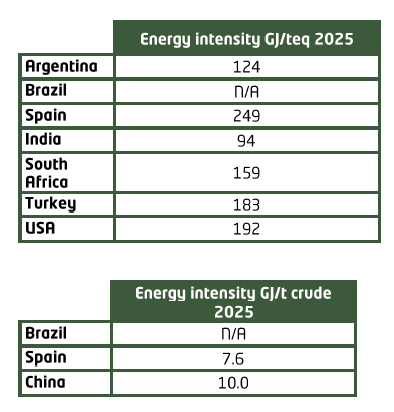
The calculation takes into account internal energy consumption, equivalent towers, and tons of flanges produced.
External energy consumption
The calculation and availability of data for estimating Scope 3 emissions are highly complex. Work is currently underway to define a methodology that will enable the calculation of this energy consumption. This information is expected to be reported in the 2026 annual report.
Energy consumption from renewable sources
In 2025, 7.33% of the group’s total energy consumption came from renewable sources (vs. 7.78% in 2024). The slight decrease is due to lower electricity consumption in Brazil (a facility with certified renewable electricity) and a higher proportion of energy consumption in China. At the same time, solar self-consumption increased thanks to the first full year of operation of the South African facility and the expansion at SIHI, bringing the number of sites with PV to nine.
Electricity consumption from renewable sources:
- PV self-consumption: 2.99% of the total (+1 pp vs. 2024), with 9 facilities in operation (including 6 factories in China, Reducel, Galicia, and South Africa).
- Electricity from PPAs/RECs: 4.34% of the total (-1.41 pp vs. 2024), at 7 factories
Energy Efficiency
Coating of paint booths at GRI Towers Galicia
At GRI Towers Galicia, various studies are being conducted aimed at reducing energy consumption in the paint booths. The main energy consumption in tower manufacturing is concentrated in the paint drying booths; therefore, one of the key actions within the Carbon Neutral Plan, focused on reducing Scope 1 emissions, has been the comprehensive lining of these booths.
The cladding process was carried out in two phases: two booths were retrofitted in 2021 and the remaining two in 2022.
Analysis of natural gas consumption records shows that, between 2020 (pre-insulation) and 2025 (all booths insulated), a reduction of 3,393.79 kWh/equivalent tower (12.2 GJ/equivalent tower) was achieved.
On the other hand, the table below shows an increase in consumption per equivalent tower compared to 2024. This increase is explained by the painting schemes applied during 2025, which required a greater amount of product and energy during the process.
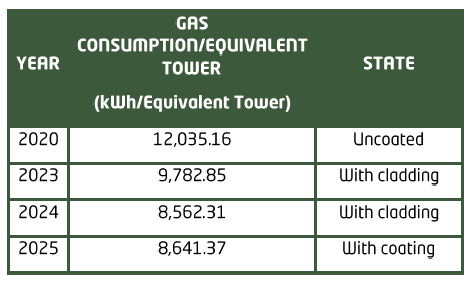
Throughout 2025, energy consumption continued to be monitored via meters installed in the paint booths, which has enabled the identification of opportunities to implement energy efficiency measures.
As previously noted, studies aimed at optimizing painting and drying processes continue at GRI Towers Galicia. Although these analyses have not yet been completed, results and conclusions are expected to be available throughout 2026, enabling progress in improving the process’s energy performance.
Information on GHG Emissions
CO₂ emissions are calculated in accordance with the principles and methodologies of the GHG Protocol and the 2006 IPCC Guidelines for National Greenhouse Gas Inventories, using annually updated emission factors and the organization’s activity data.
Information on greenhouse gas emissions is the cornerstone of the company’s decarbonization plan. The inventory covers all activities, countries, energy sources, and greenhouse gases within the company.
Scopes 1 and 2
Scope of the Greenhouse Gas Inventory
The scope of GRI Renewable Industries’ greenhouse gas (GHG) inventory has been defined according to the control approach in line with the criteria established in the GHG Protocol and the GRI 305 standard.
Under this approach, the inventory includes in Scopes 1 and 2 the emissions associated with the Group’s own operations over which GRI Renewable Industries exercises financial control, as well as those operations under its operational control.
The greenhouse gases included in the inventory are: CO₂, CH₄, N₂O, HFCs, HCFCs, and SF₆, in accordance with the scope defined by the Kyoto Protocol and the GHG Protocol.
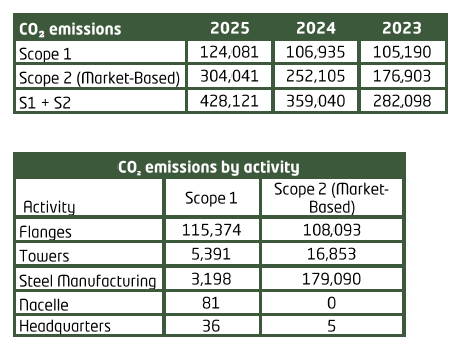
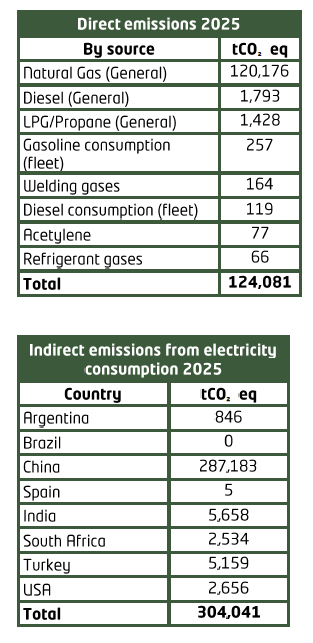
In 2025, GRI emitted a total of 124,081 tCO₂eq into the atmosphere, corresponding to direct emissions (Scope 1). Direct GHG emissions stem primarily from the consumption of fossil fuels (natural gas, liquefied petroleum gases, and diesel) in production processes and the company’s vehicle fleet (diesel and gasoline). Indirect emissions from electricity consumption amount to 306,635 tCO₂eq, taking into account the location-specific emission factor. However, because GRI purchases renewable energy at 7 of the group’s factories, these emissions are reduced to 304,041 tCO₂eq. The latter figure represents the market emission factor used as a reference within the group and in the indicators of this report.
External Assurance and Verification
To reinforce the reliability and traceability of the reported information, GRI will submit its inventory and certain product statements to independent verifications conducted by accredited third parties in 2025:
- Corporate inventory (2024): verified in accordance with UNE-EN ISO 14064 for the organizational scope covering Spain, Brazil, Turkey, and the United States, covering scopes 1, 2, and 3.
- Product carbon footprint (2024): verified in accordance with ISO 14067 for wind tower flanges manufactured by Iraeta Energy Equipment Co., Ltd., using a cradle-to-gate approach.
- Recycled content: verified in accordance with ISO 14021 for Iraeta’s continuous casting billets and steel ingots, confirming the incorporation of recycled material (including post-consumer scrap).
Emissions Avoided
In fiscal year 2025, GRI manufactured 1,579 equivalent towers.
Considering the annual net operating hours of the turbines in the countries where they are located, the installed capacity, the electricity emission factor applicable to each country, and the percentage of the tower cost relative to the total cost of the wind turbine (16.4%), it is estimated that the towers manufactured by GRI in 2025 have avoided a total of 383,310 tons of CO2.
Carbon Neutral Plan
Objectives
The Carbon Neutral Plan sets the goal for GRI Renewable Industries to become a climate-neutral company by 2050. As an intermediate step, the Group has set 2030 targets to reduce its emissions, aligned with the 1.5 °C target of the Paris Agreement.
With 2020 as the base year and a global scope, the 2030 targets are:
- Reduce Scope 1 emissions by 50%.
- Ensure that 100% of purchased energy comes from renewable sources.
2020 was chosen as the base year following the expansion of the emissions scope with the addition of new factories in 2019 and because comprehensive and robust emissions inventories were available.
In 2025, the Group achieved an emissions intensity of 14 tons of CO₂ per equivalent tower and 1.3 tons of CO₂ per ton of flange, as a result of the energy mix used in its operations.
The Group’s strategy is based on three lines of action: improving process efficiency, increasing the use of renewable electricity, and advancing the electrification of processes currently based on fuels.
Performance 2025
Scope 1 emissions increased by 16% compared to 2024. Regarding Scope 2 emissions, 7.33% of the electricity consumed in 2025 came from renewable sources. Total Scope 2 emissions increased by 21% compared to 2024.
During the fiscal year, GRI is conducting an internal review of the approach of its Decarbonization Plan to assess its alignment with business developments and the experience gained in recent years. This analysis stems from the observation that absolute emissions targets, while aligned with the principles of the Paris Agreement, do not always fully reflect operational and efficiency improvements in a context of industrial growth. In this context, the group is analyzing alternative methodologies for monitoring environmental performance that allow for a more representative view of its operations, in line with international benchmarks and the applicable regulatory framework.
Environmental Reporting Tool
Throughout 2025, work has continued on the environmental reporting platform for energy and material consumption and waste generation at GRI plants, with the aim of optimizing environmental management and identifying areas for improvement.
Information is reported at the plant level, providing the corporate Environment department with a comprehensive and consolidated view of the group’s environmental performance. This approach facilitates comparisons between plants, the creation of aggregated statistics and charts, and the identification of best practices that can be replicated across the organization, thereby contributing to the fulfillment of the company’s environmental strategy.
Currently, the system integrates data for the years 2023, 2024, and 2025, enabling robust comparative analyses and the establishment of improvement targets based on real and verified trends.
Other Emissions
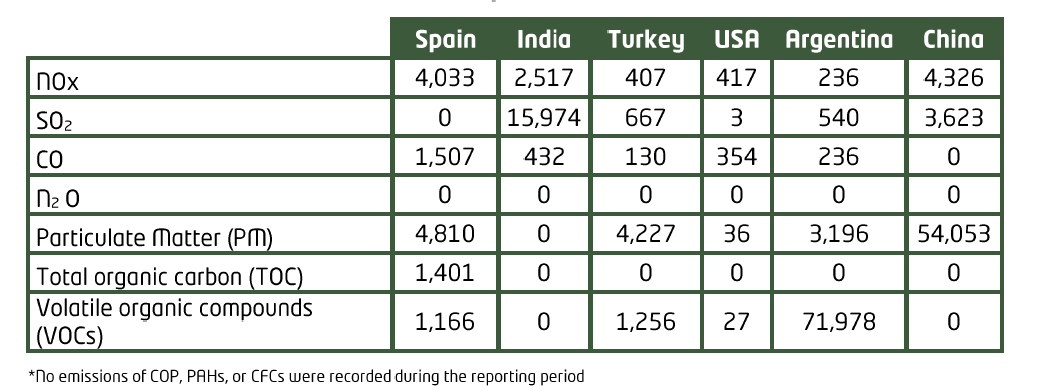
Regarding emissions from other sources, these are sporadic, and controls are carried out by an accredited body at the frequency established in the corresponding licenses or other legal requirements. Below, we summarize the main emissions in kg:
Circular Economy: Raw Materials and Waste
Circular Economy: Raw Materials and Waste
In recent years, the circular economy has emerged as a key issue in corporate environmental management, reinforced, among other factors, by the European Green Deal, the Spanish Circular Economy Strategy, and the 2030 Agenda. At GRI Renewable Industries, rather than an end goal, the circular economy is a tool that guides the continuous improvement of production processes and environmental responsibility.
Life Cycle of a Wind Tower and GRI’s Role
The stages of a wind tower’s life cycle are diverse. The process is summarized below, highlighting those in which GRI Renewable Industries is involved:
- Procurement of raw materials and components: This includes extraction and manufacturing. In towers, steel is the primary component (more than 95% of the total) and the one with the greatest impact on emissions, along with the electrical and electronic materials installed inside.
- Production (GRI scope): This covers the processes and consumption of energy and raw materials for the manufacture of sections, flanges, and the installation of the internal components that make up the tower.
- Transportation: The supplier typically manages the logistics for steel plates; the customer manages those for the finished product (sections) to the wind farm, usually by truck and/or ship. Additionally, GRI is responsible for logistics between its flange factories and its tower plants or other customers.
- Installation, operation, and maintenance (outside the GRI scope): This includes site preparation, access roads, transportation, and grid connection. The estimated useful life of a wind farm is 20–25 years. This stage highlights the positive impact of renewable energy generation, which does not require fossil fuels, as well as the management of potential impacts on birdlife and the environment.
End of useful life: Dismantling and material separation. The towers are nearly 100% recyclable; the turbine is more complex, although it is currently possible to separate most materials, and only a small fraction requires thermal treatment or disposal in a landfill.
Waste Reduction Strategy and Targets for 2030
The company has adopted the following corporate objectives regarding waste and the circular economy:
- 0% waste to landfill by 2030.
- Reduce hazardous waste by 25% by 2030.
- Reduce non-hazardous waste by 25% by 2030.
Setting strategic goals and objectives is a fundamental step, to which GRI is fully committed. To achieve them, various actions are carried out at production plants. In line with this approach, a series of short-term operational objectives have also been defined within the scope of the Environmental Management System:
- Waste recovery target: exceed 65% by 2026, excluding scrap metal as a fraction, using 2025 as the base year.
- Target for reducing and controlling waste sent to landfills per plant by 2026: measured in kg of waste to landfill per unit of production, with the following maximum values per site: Seville 3,210 kg; South Africa 582 kg; Argentina 1,006 kg; Amarillo (USA) 726 kg; Galicia 41 kg. Maintenance of levels at plants with maintenance KPIs: Turkey I and II 0 kg; India I 65 kg; India II 20 kg.
Raw materials
The towers are primarily made of steel (structure), in addition to electrical and electronic equipment. Packaging is of very little significance.
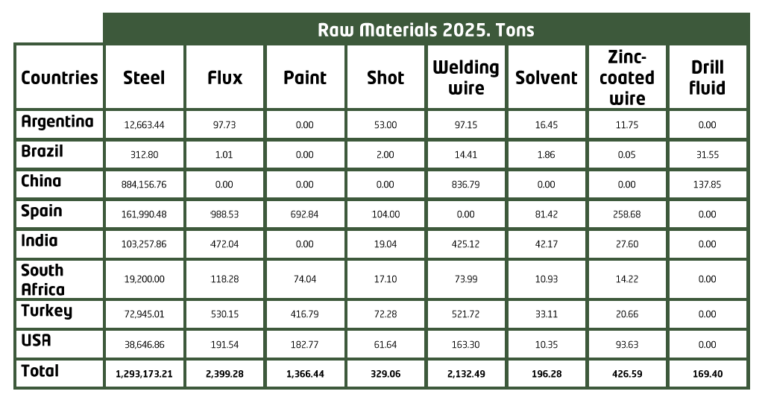
The weight of the main raw materials purchased in 2025 totaled 1,293,173.21 tons, with steel accounting for 99% of the total.
Steel, the main component of GRI Renewable Industries’ processes, is one of the primary materials used by the global economy. This characteristic positions it as the circular material par excellence and, in turn, is driving the comprehensive transformation of the steel manufacturing sector.
In 2025, a total of 1,293,173.21 tons of steel were consumed, of which an estimated 13%* was recycled.
Furthermore, regarding the procurement of materials, GRI Renewable Industries has formalized its policy on conflict minerals, committing to operate in accordance with the principles of the Dodd-Frank Wall Street Reform Act and the European Conflict Minerals Regulation. This policy is available on the website.
Furthermore, the procurement process includes the corresponding supplier certification. During this process, steel and electrical and electronic materials were identified as those that may potentially contain these minerals in their composition, which is why this information is required.
*Estimated figure based on the World Steel Association’s LCA eco-profiles updated in June 2023.
Waste Management and Minimization
The Circular Economy involves reducing waste to a minimum and keeping a product’s materials and components within the economy when it reaches the end of its useful life, whenever possible. Thus, they have added value by being productively reused time and again.
At GRI Renewable Industries, we have procedures and guidelines in place to ensure that the waste generated is properly sorted, monitored, identified, stored, and managed through authorized waste management companies.
In 2025, a total of 81,664 tons of waste was generated, of which 95% is non-hazardous and less than 5% is hazardous waste.
Non-hazardous waste: A total of 77,458 tons was generated. Steel scrap accounted for 94% of this total, amounting to 73,007 tons.
Regarding scrap, GRI Renewable Industries has an integrated system across all plants for the centralized collection and recovery of steel discarded during production.
In September 2022, the new GRI China V plant began operations, with two divisions: one for the manufacture of forgings and another for the production of electric arc furnace steel, sourced from scrap generated at all GRI plants in China. This is a significant milestone, as it helps close the loop and reuse all generated waste to produce new steel within the framework of the circular economy.
All steel scrap is managed for recycling, so it is subsequently reintroduced into the value chain, thereby promoting the production of steel from recycled material, which results in significant savings in raw materials and emissions.
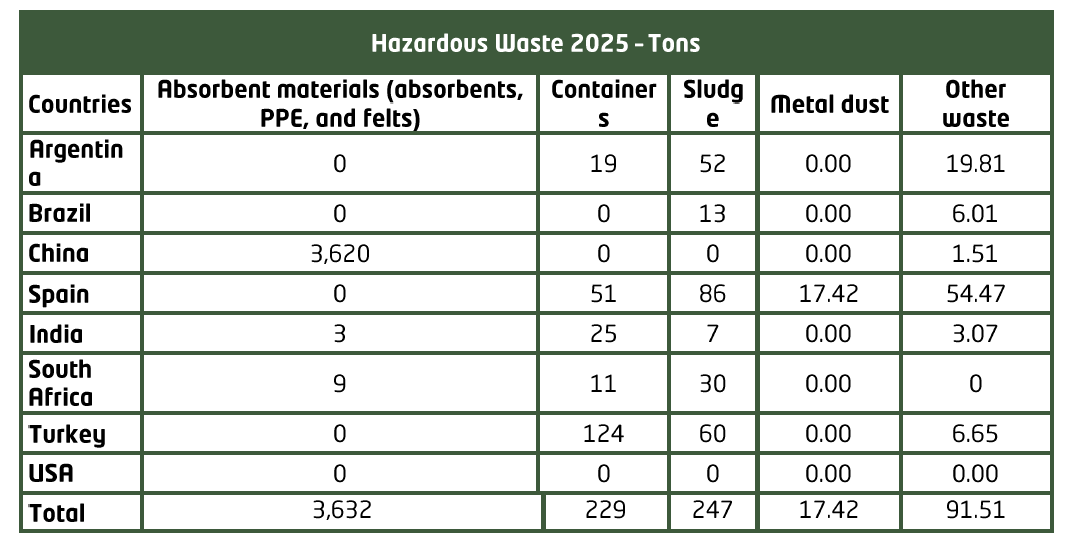
Hazardous waste: A total of 4,218 tons were generated. Notable categories include absorbent materials (86%), packaging (6%), and paint sludge (5%).
All waste generated, based on its characteristics, has been handled by authorized transporters and waste management companies within the country (306-4).
Considering the total waste produced, it is estimated that 92.3% is recycled (mainly steel) and the remaining 7.7% is disposed of in landfills or through incineration and recovery processes.
In fiscal year 2025, there were no significant spills (306-3).
Corporate “Zero Waste” Committee
Within the framework of the strategy and objectives described above, the “Zero Waste” committee has been established, a corporate forum in which all the group’s environmental managers participate. The purpose of this committee is to foster the exchange of experiences, challenges, and knowledge among plants, promoting the identification of opportunities and the implementation of measures that reduce environmental impact.
The main objective is to move toward a “zero waste” model by promoting alternative management methods that allow for the recovery of existing waste—either as recyclable materials or as inputs for other production processes—thereby strengthening the circular economy within the organization.
These committees play a key role in facilitating the cross-functional sharing of knowledge, sharing success stories, analyzing challenges encountered, and highlighting innovative initiatives across the various plants. Thanks to this continuous exchange, the adoption of more efficient solutions is encouraged, resource use is optimized, and efforts are aligned to maximize waste reduction and recovery across the entire group.
Throughout 2025, committee meetings were held on a quarterly basis, with very high and active participation from attendees. In addition, new topics were proposed for future sessions, reinforcing the collective commitment to continuous improvement and the circularity of materials.
Responsible waste management is a cornerstone of the environmental strategy. Taking a preventive approach minimizes impacts, improves process efficiency, and aligns operations with the principles of the circular economy.
Minimizing waste sent to landfills is a priority at all plants, promoting alternatives such as reuse, recycling, and material recovery or, where appropriate, their use as inputs in other processes.
This approach facilitates opportunities for improvement, reduces treatment costs, and reinforces the internal culture of sustainability, driving improvements in processes, materials, and technologies that promote circularity.
2025 Projects
- Waste Minimization
- Cleaning of paint cans: In India I, a can cleaner has been used to reduce this hazardous waste to zero. The system has been in place since 2017 in Galicia and since 2019 in Seville, with positive results.
- Reduction of Waste Sent to Landfill
General guidelines: prevent the most bulky waste fractions from ending up in landfills (e.g., flux, shot blasting grit) and seek alternatives for waste with a greater environmental impact (e.g., paint sludge).
2025 Projects:- Flux recovery: Turkey and Argentina made contacts and conducted sampling for its acceptance at a cement plant. Technical acceptance exists, but implementation could not be carried out in 2025 due to operational issues; these are expected to be resolved in 2026.
- Seville: sludge from the cutting machine and scrap metal residues have been diverted from landfills to recycling.
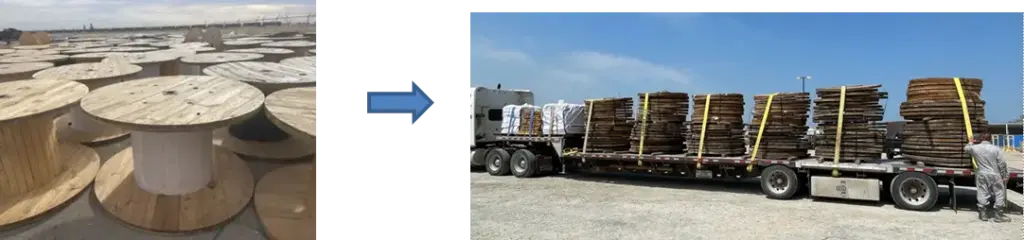
- Wood Reuse
- Pallets: sold for reuse at virtually all plants.
- Wooden reels: donated to a local artisan (Argentina).
Internal reuse: wood unsuitable for sale is used as support for veneers or for other purposes within the plant.
In areas involving forest-derived materials, the use of FSC-certified wood is encouraged.
- Washing and reuse of contaminated rags
Project implemented in Seville, the Basque Country, and Galicia, with a 100% reduction of this waste stream in the areas where it is applied. In operation since 2017 (Galicia) and 2019 (Seville). In 2025, South Africa conducted trials with various suppliers; although optimal results were not achieved, the work will continue in 2026. The experience is shared with plants that do not yet have this system to assess its implementation. - Solvent Recovery
Considered a key lever for reducing hazardous waste and raw material consumption. Units exist in Galicia, Brazil, India I, Turkey I, and South Africa. By 2026, implementation is planned in the United States, Argentina, and India II, advancing the standardization of best practices.
Biodiversity
The protection and conservation of different ecosystems, both terrestrial and aquatic, must be a priority for everyone. Ensuring this legacy for future generations is a commitment that guides us and is directly related to SDG 15 “Life on Land.”
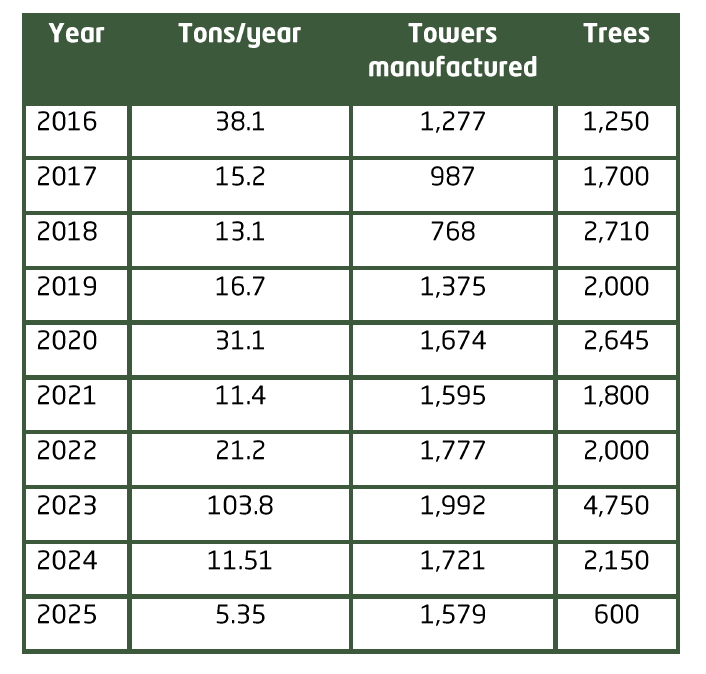
GRI Renewable Industries aims to respect natural capital, biodiversity, and cultural heritage in the environments where it operates. To this end, and alongside other measures, it has been carrying out reforestation efforts since 2016 as part of the “One Tower, One Tree” initiative, through which it commits to planting one tree for every tower manufactured.
In 2025, a reforestation project was carried out, with 600 trees planted. Reforestation is an activity that seeks to restore degraded habitats to their original conditions. Reforestation is always carried out using native species and promoting crop diversity; the goal is to lay the groundwork for the development of healthy forests in the vicinity of the group’s factories. Since the project’s inception, a total of 21,605 trees have been planted, with an estimated cumulative absorption capacity of 267 tons of CO2 per year.
GRI Renewable Industries’ factories are not located in or near protected areas. All of them have the corresponding licenses and environmental studies, and no impact on biodiversity or protected species has been detected (304-1, 304-3, and 304-4).
Water and Wastewater
Water is a natural, limited, scarce resource essential for life on Earth. It is a fundamental part of sustainable and socioeconomic development. However, current projections (OECD) indicate that, if we continue as we have been, by 2050 nearly half of the world’s population will live in areas under severe water stress.
In this regard, although GRI Renewable Industries is not a major consumer of water in its production processes, consumption is monitored to protect water resources and ensure their efficient and sustainable use, as well as to identify deviations or potential actions for improvement and reduction of consumption.
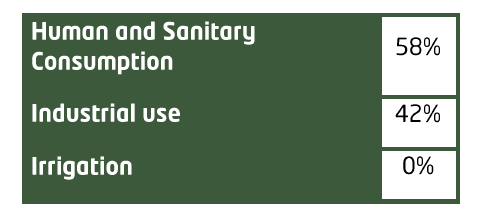
In 2025, total consumption was 104,350 m³, 13% less than in 2024. Regarding the source, 79% of the water consumed came from the municipal supply, 14% from groundwater, and 7% from surface water.
No water source has been significantly affected by the company’s water abstraction (306-5).
Soil
Preventing soil contamination is an important aspect of environmental management within the company. The group’s factories have the procedures and resources in place to respond quickly to any incident and conduct awareness-raising activities to educate all employees.
In addition, they monitor and report any spills or leaks that occur, describing the incident and the actions taken.
Noise
In general, external noise is not a significant impact at GRI Renewable Industries’ factories. Most are located in industrial parks, away from urban areas, which minimizes this impact.
Likewise, all facilities are equipped with sectional doors—both roll-up and fixed types—featuring automatic closing mechanisms that prevent noise emissions to the outside, as well as soundproof enclosures on those parts of the production lines where the highest noise levels occur, to protect workers (in addition to the use of appropriate hearing protection PPE in each case).
All factories prepare their corresponding external noise reports at the frequency established in their environmental permits and/or environmental impact studies and/or the country’s local legislation. Furthermore, to minimize the noise impact of transporting raw materials and finished products by truck, the permitted and established loading and unloading schedules are strictly adhered to.
If any non-compliance is detected, appropriate corrective measures are implemented.
Light Pollution
All of the group’s facilities are located in industrial zones and either already have or are in the process of installing LED lighting, which minimizes the impact. Their impact on light pollution is not material.