
SUSTAINABILITY REPORT 2025
GRI Renewable Industries
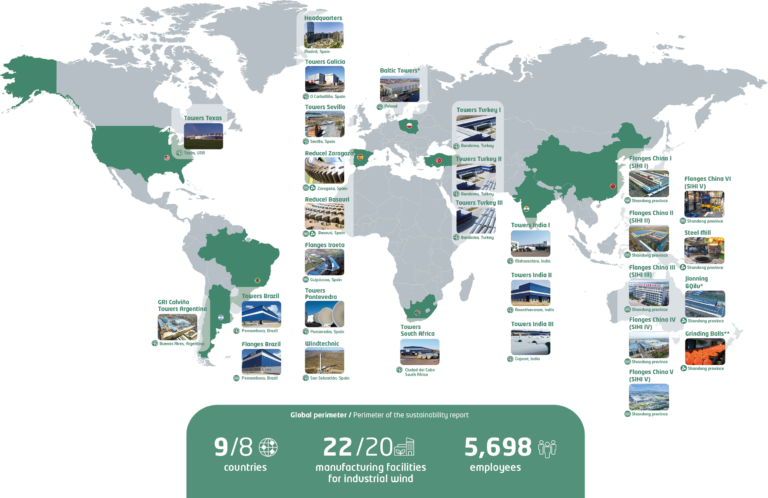
Since 2008, GRI Renewable Industries has been a leading global manufacturer of wind turbine components, with 22 factories across nine countries, including the United States, Brazil, Spain, South Africa, Turkey, India and China, as well as Argentina and Poland, where the group participates in industrial projects through joint ventures. In 2025the Group reported sales exceeding €1 billion, an operating profit of over €87 million, and 5,698 employees, including direct and indirect employees.
The company is characterized by a deep-rooted industrial culture and constant innovation in all processes related to the design, manufacturing, assembly, distribution, and installation of towers and flanges for the wind energy sector. Its value proposition is based on adapting to the needs of each client with a commitment to excellence and continuous improvement.
Sustainability is an integral part of the management model, focused on the objectives of safety, health, quality, and respect for people and the environment, with the aspiration of building a more sustainable and emission-free future.
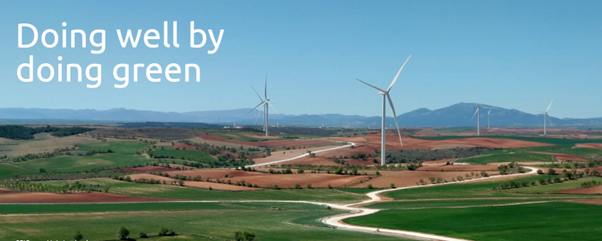
GRI Renewable Industries strives to grow as a solid and responsible industrial company, upholding the values of honesty, humility, perseverance, and hard work established by its founder. These ethical and business values inspire the purpose “Doing Well by Doing Green,” reflecting the conviction that only by acting correctly and consistently can we create a more sustainable and emission-free future for everyone.
- Purpose: “Doing well by doing green”
- Vision: A global leader and innovator in the manufacture of wind power components, creating a more sustainable and emission-free future.
- Mission: To meet our customers’ needs globally while taking into account their operations, the safety of our employees, and respect for the environment
Busines Lines

Key milestones in 2025
- GRI Towers Galicia recognized for its innovation at Energy Days ’25
- The Board of Directors of the Industrial Union of the Province of Buenos Aires visits GRI Calviño Towers Argentina
- GRI participates in the main wind energy industry events in Brazil
- GRI Towers Sevilla and the University of Seville partner to drive innovation in the wind energy sector
- Gonvarri and GRI, together with the Real Madrid Foundation, join forces to bring hope
- GRI: A Success Story in the Employment of Refugees
- Iraeta recognized for its support of Basque vocational training
- GRI Towers India I launches the Integrated Development Program
- GRI Texas Strengthens Its Social Commitment with Martha’s Home
- GRI Flanges Brazil celebrates 1,000 days without accidents
- First month without lost-time accidents in 12 years
- GRI Attends the 9th Spain-China Forum
- New GRI Plant in Turkey
- Marine Energy Conference in Galicia: GRI drives innovation with Floatwind and RISS
- Floatwind: GRI R&D drives innovation in floating offshore wind
- GRI Flanges Iraeta publishes its Environmental Product Declaration (EPD)
- Expansion of the rooftop photovoltaic generation system at GRI Towers South Africa
- Iraeta Forgings Connects a Photovoltaic Power Generation Project to the Grid
Materiality
Relationships with various stakeholders are a key aspect at GRI Renewable Industries. Therefore, since 2013, these relationships have been analyzed and updated to improve coverage, gain a better understanding of stakeholder expectations, and align the content of the Report with their primary ESG (Environmental, Social, and Governance) requirements.
GRI maintains specific communication channels for each identified stakeholder group. Communication is two-way, and there is no set frequency, as the requirements of each stakeholder group differ.
Given that GRI’s products represent an intermediate stage in the final product’s value chain, external visibility and media presence are limited. Therefore, the company considers the most relevant stakeholders—and those with the greatest impact on its operations—to be: Management, Employees, Customers, and Suppliers.
Shareholders | • Quarterly results on the agenda of the Board of Directors. • Regular meetings and reports between General Managers and the CEO. • Leadership Meeting 2023. |
Employees | • Global workplace climate surveys. • “Leading The Change” intranet. • Interdepartmental meetings with management. • Informational meetings with the CEO. • Works Council and Health and Safety Committee. • Biennial survey. Materiality study. |
Clients | • Catalogs, presentations, and trade show booths. • Communication tools, e.g., “B2B platforms.” • Annual satisfaction survey. • Regular visits and meetings. • Incident management. • Collaboration on improvement projects. • Biennial survey. Materiality study. |
Suppliers | • Supplier evaluation surveys. • Regular visits and meetings. • Supplier portal. • Complaint management. • Biennial survey. Materiality assessment. |
Local Communities and Governments | • Relations with local government, associations, and other organizations managed by each factory’s management. • Events and open houses. • Institutional meetings. |
Industry | • Forums and associations. • Ad hoc collaborations. |
Nonprofit sector | • Joint initiatives with third sector organizations. • Partnerships and volunteer work. |
Society | • Social media, which allows us to reach a wider audience. • News. • Forums and associations. |
Media | • Daily analysis of relevant news. • Press releases. • Social media channels and websites. |
GRI identifies its material issues through a “Materiality Assessment” conducted in collaboration with an independent external firm and using a technological tool for data and information analysis, which evaluates the importance and perception of the identified issues.
The materiality assessment enables GRI to identify relevant issues and align them with its business strategy, while identifying the expectations and needs of stakeholders.
The materiality assessment is conducted every two years. The most recent assessment was conducted in fiscal year 2022, and in 2024 we began adapting to the CSRD, including the double materiality analysis, which has not been incorporated into this report as it is not covered by the GRI standard, leading to a one-year extension of the 2022 materiality assessment.
To conduct the study, both internal (management) and external perspectives are combined. In the first phase, internal sources (policies, strategy, commitments, etc.) and external sources (news, benchmarking of competitors and key customers, market trends in CSR and industry-specific trends, new legal requirements, etc.) are consulted. Based on this, the most relevant issues and those that could have the greatest impact on the company are assessed.
All this information is organized into 25 questions within the ESG framework. Each question assesses the relevance of each issue and the perception of the company’s commitment and progress regarding GRI standards for each issue.
The survey is administered and weighted by an external firm, ensuring the independence and transparency of the results. As previously noted, the survey targets management and employees, as well as a selection of key customers and suppliers, as these are the most relevant stakeholders. Management is also consulted regarding the maturity of these issues within the company, given their ability to influence them.
This process allows us to identify the environmental, social, and governance (ESG) issues most relevant to GRI and its stakeholders.
Internal and External Coverage
A total of 940 surveys were sent to management, employees, customers, and suppliers, with an average response rate of 48% across all groups. The participation rates for each stakeholder group are summarized below:
| Participation | Sent | Responded |
Management | 100% | 23 | 23 |
Employees | 58% | 853 | 499 |
Customers | 23% | 43 | 10 |
Suppliers | 52% | 21 | 11 |
The following is a summary of the material issues identified:
Environmental Issues
Topics Included
SDGs
Carbon Neutral Strategy
Commitments and Strategic Plan to Move Toward a “Carbon Neutral” Future
7, 13
Environmental Management
Formal policy and management systems that contribute to continuous improvement and the minimization of the company’s environmental impact.
12
Circular Economy
A system for controlling and measuring raw materials, minimizing waste, and ensuring sustainable management, which promotes the Circular Economy.
12
Social Issues
Topics included
SDGs
Talent Management
Robust training, professional development, and performance evaluation programs that contribute to attracting and retaining talent.
4, 8
Health and Safety
Availability of a health and safety policy and management system for employees and subcontractors, contributing to a positive work environment and reducing workplace accidents and incidents.
3
Human Rights in the Supply Chain
Existence of policies and procedures for compliance with criteria regarding ethics, sustainability, and human rights, among others.
2, 17
Flexibility
Policies, measures, and initiatives that allow workers to adapt their work schedules to their needs and improve work-life balance.
8
Customers
Customer relationships and collaborative projects that contribute to the development of
more sustainable products.
8, 12
Innovation
Projects and initiatives aimed at improving and increasing the efficiency of products and processes.
9
Corporate Governance Issues
Topics included
SDGs
Ethics, compliance, and
Whistleblowing channels
Ethics, anti-corruption, and compliance framework. Monitoring and measurement.
Whistleblowing channels.
8, 16
Risks
Framework for identifying, monitoring, mitigating, and controlling potential risks.
8, 16
Human Rights Policy
Policy
A formal and public policy that sets forth the company’s commitments regarding human rights.
8, 16
Cybersecurity
Policies, measures, training, and risk management regarding cybersecurity, information security, and the protection of data and assets.
9
In the materiality analysis conducted in 2022, compared to the previous one in 2020, five new issues relevant to stakeholders stand out: Human Rights, Flexibility, Risks, Innovation, as well as cybersecurity, information security, and data/asset protection.
In addition, responses from each stakeholder group were analyzed to obtain information on material issues not covered comprehensively. The results show that:
- For internal stakeholders, diversity is considered material (in addition to the above).
- For external stakeholders, policy and due diligence regarding Conflict Minerals, as well as measures related to cybersecurity, information security, and data/asset protection, are considered material (in addition to the aforementioned topics).
All reported material topics are identified in the GRI content index and in each section of the corresponding report.
The study also measures the internal and external perceptions that stakeholders have regarding GRI Renewable Industries’ approach and implementation of the issues surveyed.
For internal stakeholders, a high level of perceived importance is shown for the following issues: Carbon Neutral strategy, environmental management, health and safety, and cybersecurity and data protection. For external stakeholders, the issues that reflect the highest degree of perceived importance are:
Suppliers: carbon neutral strategy, environmental management, health and safety, and conflict minerals.
- Customers: health and safety, diversity, human rights (internal and in the supply chain), and innovation.
- Employees: environmental management, and cybersecurity and data protection.
Identified material issues:Environmental
- Carbon Neutral Strategy
- Environmental Management System (EMS)
- Circular Economy (CE)
- Mobility
- Biodiversity
- Customers
Social
- Training and Management by Objectives
- Health and Safety
- Diversity
- Human Rights Policy
- Supply Chain Human Rights
- Flexibility
- Local Community
Governance
- ESG
- Compliance
- Risks
- Innovation
- Digitalization
- Cybersecurity
- Minerals
- Communication
- Government
- Partnerships
- Sustainability Indices
- Funding